STOICHIOMETRY


The word stoichiometry derives from two Greek words: stoicheion (meaning "element") and metron
(meaning "measure"). Stoichiometry deals with calculations about the
masses (sometimes volumes) of reactants and products involved in a
chemical reaction. It is a very mathematical part of chemistry, so be
prepared for lots of calculator use.
Jeremias Benjaim Richter (1762-1807) was the first to lay down the principles of stoichiometry. In 1792 he wrote:
"Die stöchyometrie (Stöchyometria) ist die Wissenschaft die quantitativen oder Massenverhältnisse zu messen, in welchen die chymischen Elemente gegen einander stehen."
[Stoichiometry is the science of measuring the quantitative proportions or mass ratios in which chemical elements stand to one another.]
All reactions are dependent on how much stuff you have. Stoichiometry helps you figure out how much of a compound
you will need, or maybe how much you started with. We want to take the
time to explain that reactions depend on the compounds involved and how
much of each compound is needed.
What do you measure? It could be anything. When you're doing problems in stoichiometry, you might look at...
- Mass of Reactants (chemicals before the reaction)
- Mass of Products (chemicals after the reaction)
- Chemical Equations
- Molecular Weights of Reactants and Products
- Formulas of Various Compounds

The most common stoichiometric problem will present you with a
certain amount of a reactant and then ask how much of a product can be
formed. Here is a generic chemical equation:
2 A + 2B ---> 3C
Here is a typically-worded problem (often called a "mass-mass" problem):
Given 20.0 grams of A and sufficient B, how many grams of C can be produced?
You will need to use molar ratios, molar masses, balancing and
interpreting equations, and conversions between grams and moles. If you
struggled with those in class, welcome to the club. Go back and review
them if you need to, because if you can't do that stuff, you can't do
stoichiometry.
Stoichiometry is a section of chemistry
that involves using relationships between reactants and/or products in a
chemical reaction to determine desired quantitative data. In Greek, stoikhein means element and metron means
measure, so stoichiometry literally translated means the measure of
elements. In order to use stoichiometry to run calculations about
chemical reactions, it is important to first understand the
relationships that exist between products and reactants and why they
exist, which require understanding how to balanced reactions.
Balancing
In
chemistry, chemical reactions are frequently written as an equation,
using chemical symbols. The reactants are displayed on the left side of
the equation and the products are shown on the right, with the
separation of either a single or double arrow that signifies the
direction of the reaction. The significance of single and double arrow
is important when discussing solubility constants, but we will not go
into detail about it in this module. To balance an equation, it is
necessary that there are the same number of atoms on the left side of
the equation as the right. One can do this by raising the coefficients.
Reactants to Products
A
chemical equation is like a recipe for a reaction so it displays all
the ingredients or terms of a chemical reaction. It includes the
elements, molecules, or ions in the reactants and in the products as
well as their states, and the proportion for how much of each particle
is create relative to one another, through the stoichiometric
coefficient. The following equation demonstrates the typical format of a
chemical equation:
In the above equation, the elements present in the reaction are represented by their chemical symbols. Based on the Law of Conservation of Mass,
which states that matter is neither created nor destroyed in a chemical
reaction, every chemical reaction has the same elements in its
reactants and products, though the elements they are paired up with
often change in a reaction. In this reaction, sodium (Na ), hydrogen (H ), and chloride (Cl )
are the elements present in both reactants, so based on the law of
conservation of mass, they are also present on the product side of the
equations. Displaying each element is important when using the chemical
equation to convert between elements.
Stoichiometric Coefficients
In
a balanced reaction, both sides of the equation have the same number of
elements. The stoichiometric coefficient is the number written in front
of atoms, ion and molecules in a chemical reaction to balance the
number of each element on both the reactant and product sides of the
equation. Though the stoichiometric coefficients can be fractions, whole
numbers are frequently used and often preferred. This stoichiometric
coefficients are useful since they establish the mole ratio between
reactants and products. In the balanced equation:
we can determine that 2 moles of HCl
will react with 2 moles of Na(s) to form 2 moles of NaCl(aq) and 1 mole of H2(g) . If we know how many moles of Na we start out with, we can use the ratio of 2 moles of NaCl to 2 moles of Na to determine how many moles of NaCl were produced or we can use the ration of 1 mole of H2 to 2 moles of Na to convert to NaCl . This is known as the coefficient factor. The balanced equation makes it
possible to convert information about one reactant or product to
quantitative data about another element. Understanding this is essential
to solving stoichiometric problems.
Example 1
Lead (IV) hydroxide and sulfuric acid react as shown below. Balance the reaction.
Solution:
Start by counting the number of atoms of each element.
UNBALANCED
Element
|
Reactant (# of atoms)
|
Product (# of atoms)
|
Pb
|
1
|
1
|
O
|
8
|
9
|
H
|
6
|
2
|
S
|
1
|
2
|
The
reaction is not balanced; the reaction has 16 reactant atoms and only
14 product atoms and does not obey the conservation of mass principle.
Stoichiometric coefficients must be added to make the equation balanced.
In this example, there are only one sulfur atom present on the reactant
side, so a coefficient of 2 should be added in front of H2SO4 to have an equal number of sulfur on both sides of the equation. Since
there are 12 oxygen on the reactant side and only 9 on the product side,
a 4 coefficient should be added in front of H2O where there is a deficiency of oxygen. Count the number of elements now
present on either side of the equation. Since the numbers are the same,
the equation is now balanced.
BALANCED
Element
|
Reactant (# of atoms)
|
Product (# of atoms)
|
Pb
|
1
|
1
|
O
|
12
|
12
|
H
|
8
|
8
|
S
|
2
|
2
|
Balancing
reactions involves finding least common multiples between numbers of
elements present on both sides of the equation. In general, when
applying coefficients, add coefficients to the molecules or unpaired
elements last.
A balanced equation ultimately has to satisfy two conditions.- The numbers of each element on the left and right side of the equation must be equal.
- The charge on both sides of the equation must be equal. It is especially important to pay attention to charge when balancing redox reactions.
Stoichiometry and Balanced Equations
In stoichiometry, balanced equations make it possible to compare different elements through the stoichiometric factor
discussed earlier. This is the mole ratio between two factors in a
chemical reaction found through the ratio of stoichiometric
coefficients. Here is a real world example to show how stoichiometric
factors are useful.
Example 2
There
are 12 party invitations and 20 stamps. Each party invitation needs 2
stamps to be sent. How many party invitations can be sent?
Solution:
The equation for this can be written as
where
I - represents invitations,
S - represents stamps, and
IS2 - represents the sent party invitations consisting of one invitation and two stamps.
Based on this, we have the ratio of 2 stamps for 1 sent invite, based on the balanced equation.
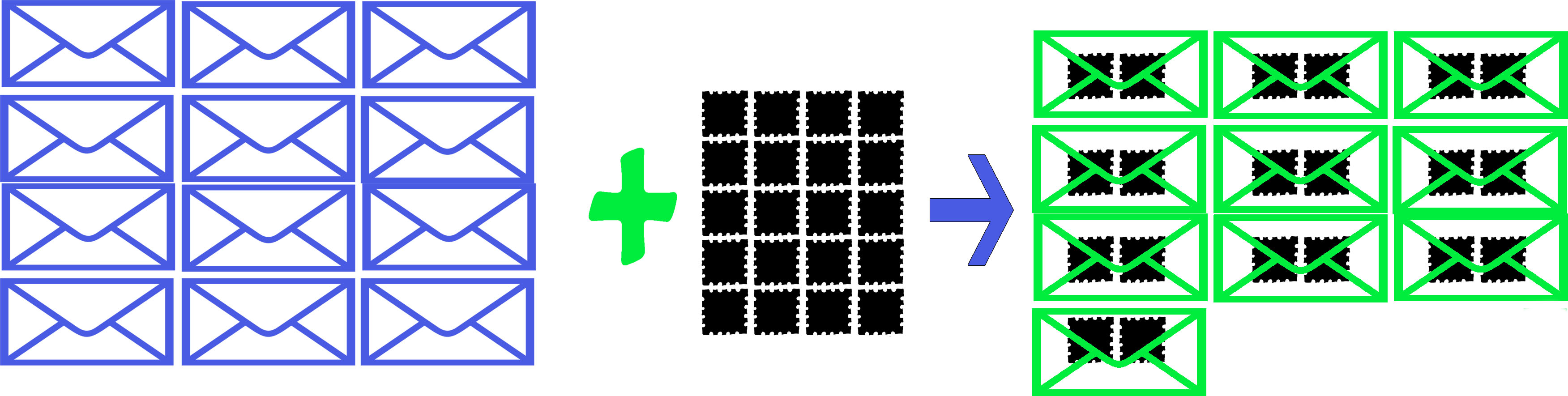
Invitation Stamps Party Invitations Sent
In
this example are all the reactants (stamps and invitations) used up?
No, and this is normally the case with chemical reactions. There is
often excess of one of the reactants. The limiting reagent, the one that
runs out first, prevents the reaction from continuing and determines
the maximum amount of product that can be formed.
Example 3
What is the limiting reagent in this example?
Solution:
Stamps,
because there was only enough to send out invitations, whereas there
were enough invitations for 12 complete party invitations. Aside from
just looking at the problem, the problem can be solved using stoichiometric factors.
12 I x (1IS2/1I) = 12 IS2 possible
20 S x (1IS2/2S) = 10 IS2 possible
When
there is no limiting reagent because the ratio of all the reactants
caused them to run out at the same time, it is known as stoichiometric proportions.
Types of Reactions
There are 6 basic types of reactions.- Combustion: Combustion is the formation of CO2 and H2O from the reaction of a chemical and O2
- Combination (synthesis): Combination is the addition of 2 or more simple reactants to form a complex product.
- Decomposition: Decomposition is when complex reactants are broken down into simpler products.
- Single Displacement: Single displacement is when an element from on reactant switches with an element of the other to form two new reactants.
- Double Displacement: Double displacement is when two elements from on reactants switched with two elements of the other to form two new reactants.
- Acid-Base: Acid- base reactions are when two reactants form salts and water.
Molar Mass
Before
applying stoichiometric factors to chemical equations, you need to
understand molar mass. Molar mass is a useful chemical ratio between
mass and moles. The atomic mass of each individual element as listed in
the periodic table established this relationship for atoms or ions. For
compounds or molecules, you have to take the sum of the atomic mass
times the number of each atom in order to determine the molar mass.
Example 4
What is the molar mass of H2O?
Solution:
Using molar mass and coefficient factors, it is possible to convert mass of reactants to mass of products or vice versa.
Example 5: Combustion of Propane
Propane (is produced?
Solution:
Steps
to getting this answer: Since you cannot calculate from grams of
reactant to grams of products you must convert from grams of C3H8
to moles of C3H8 then from moles of C3H8 to moles of H2O . Then convert from moles of H2O to grams of H2O
- Step 1: 200 g
C3H8 is equal to 4.54 molC3H8 - Step 2: Since there is a ratio of 4:1
H2O toC3H8 , for every 4.54 molC3H8 there are 18.18 molH2O - Step 3: Convert 18.18 mol
H2O to gH2O . 18.18 molH2O is equal to 327.27 gH2O
Variation in Stoichiometric Equations
Almost every quantitative relationship can be converted into a ratio that can be useful in data analysis.Density
Density (ρ )
is calculated as mass/volume. This ratio can be useful in determining
the volume of a solution, given the mass or useful in finding the mass
given the volume. In the latter case, the inverse relationship would be
used.
Volume x (Mass/Volume) = Mass
Mass x (Volume/Mass) = Volume
Percent Mass
Percents
establish a relationship as well. A percent mass states how many grams
of a mixture are of a certain element or molecule. The percent X% states
that of every 100 grams of a mixture, X grams are of the stated element
or compound. This is useful in determining mass of a desired substance
in a molecule.
Example 6
A
substance is 5% carbon by mass. If the total mass of the substance is
10 grams, what is the mass of carbon in the sample? How many moles of
carbon are there?
Solution:
10 g sample x (5 g carbon/100 g sample) = 0.5 g carbon
0.5g carbon x (1 mol carbon/12.011g carbon) = 0.0416 mol carbon
Molarity
Molarity
(moles/L) establishes a relationship between moles and liters. Given
volume and molarity, it is possible to calculate mole or use moles and
molarity to calculate volume. This is useful in chemical equations and
dilutions.
Example 7
How much 5 M stock solution is needed to prepare 100 mL of 2 M solution?Solution:
100
mL of dilute solution (1 L/1000 mL)(2 mol/1L solution)(1 L stock
solution/5 mol solution)(1000 ml stock solution/1L stock solution) = 40
mL stock solution.
These ratios of molarity, density, and mass percent are useful in complex examples ahead.
Determining Empirical Formulas
An
empirical formula can be determined through chemical stoichiometry by
determining which elements are present in the molecule and in what
ratio. The ratio of elements is determined by comparing the number of
moles of each element present.
Example 8: Combustion of Organic Molecules
1.000 gram of an organic molecule burns completely in the presence of excess oxygen. It yields 0.0333 mol of CO2 and 0.599 g of H2O. What is the empirical formula of the organic molecule?Solution:
This is a combustion
reaction. The problem requires that you know that organic molecules
consist of some combination of carbon, hydrogen, and oxygen elements.
With that in mind, write the chemical equation out, replacing unknown
numbers with variables. Do not worry about coefficients here.
Since all the moles of C and H in CO2 and H2O,
respectively have to have came from the 1 gram sample of unknown, start
by calculating how many moles of each element were present in the
unknown sample.
0.0333mol CO2 (1mol C/ 1mol CO2) = 0.0333mol C in unknown
0.599g H2O (1mol H2O/ 18.01528g H2O)(2mol H/ 1mol H2O) = 0.0665 mol H in unknown
Calculate the final moles of oxygen by taking the sum of the moles of oxygen in CO2 and H2O. This will give you the number of moles from both the unknown organic molecule and the O2 so you must subtract the moles of oxygen transferred from the O2.
Moles of oxygen in CO2:
0.0333mol CO2 (2mol O/1mol CO2) = 0.0666 mol O
Moles of oxygen in H2O:
0.599g H2O (1mol H2O/18.01528 g H2O)(1mol O/1mol H2O) = 0.0332 mol O
Using
the Law of Conservation, we know that the mass before a reaction must
equal the mass after a reaction. With this we can use the difference of
the final mass of products and initial mass of the unknown organic
molecule to determine the mass of the O2 reactant.
0.333mol CO2(44.0098g CO2/ 1mol CO2) = 1.466g CO2
1.466g CO2 + 0.599g H2O - 1.000g unknown organic = 1.065g O2
Moles of oxygen in O2
1.065g O2(1mol O2/ 31.9988g O2)(2mol O/1mol O2) = 0.0666mol O
Moles of oxygen in unknown
(0.0666mol O + 0.0332 mol O) - 0.0666mol O = 0.0332 mol O
Construct a mole ratio for C, H, and O in the unknown and divide by the smallest number.
(1/0.0332)(0.0333mol C : 0.0665mol H : 0.0332 mol O) => 1mol C: 2 mol H: 1 mol O
From this ratio, the empirical formula is calculated to be CH2O.Determining Molecular Formulas
To
determine a molecular formula, first determine the empirical formula
for the compound as shown in the section above and then determine the
molecular mass experimentally. Next, divide the molecular mass by the
molar mass of the empirical formula (calculated by finding the sum the
total atomic masses of all the elements in the empirical formula).
Multiply the subscripts of the molecular formula by this answer to get
the molecular formula.
Example 9
In the example above, it was determined that the unknown molecule had an empirical formula of CH2O.1. Find the molar mass of the empircal formula CH2O.
12.011g C + (1.008 g H) * (2 H) + 15.999g O = 30.026 g/mol CH2O
2. Determine the molecular mass experimentally. For our compound, it is 120.056 g/mol.3. Divide the experimentally determined molecular mass by the mass of the empirical formula.
(120.056 g/mol) / (30.026 g/mol) = 3.9984
4.
Since 3.9984 is very close to four, it is possible to safely round up
and assume that there was a slight error in the experimentally
determined molecular mass. If the answer is not close to a whole number,
there was either an error in the calculation of the empirical formula
or a large error in the determination of the molecular mass.
5. Multiply the ratio from step 4 by the subscripts of the empirical formula to get the molecular formula.
CH2O * 4 = ?
C: 1 * 4 = 4
H: 2 * 4 = 8
O 1 * 4 = 4
CH2O * 4 = C4H8O4
6.
Check your result by calculating the molar mass of the molecular
formula and comparing it to the experimentally determined mass.
molar mass of C4H8O4= 120.104 g/mol
experimentally determined mass = 120.056 g/mol
Example 10: Complex Stoichiometry Problem
An
amateur welder melts down two metals to make an alloy that is 45%
copper by mass and 55% iron(II) by mass. The alloy's density is 3.15
g/L. One liter of alloy completely fills a mold of volume 1000 cm3. He accidently breaks off a 1.203 cm3 piece
of the homogenous mixture and sweeps it outside where it reacts with
acid rain over years. Assuming the acid reacts with all the iron(II) and
not with teh copper, how many grams of H2(g) are released into the atmosphere because of the amateur's carelessness? (Note that the situation is fiction.)
Solution:
Step 1:
Write a balanced equation after determining the products and reactants.
In this situation, since we assume copper does not react, the reactants
are only H+(aq) and Fe(s). The given product is H2(g) and based on knowledge of redox reactions, the other product must be Fe2+(aq).
Step 2: Write down all the given information
Alloy density = (3.15g alloy/ 1L alloy)
x grams of alloy = 45% copper = (45g Cu(s)/100g alloy)
x grams of alloy = 55% iron(II) = (55g Fe(s)/100g alloy)
1 liter alloy = 1000cm3 alloy
alloy sample = 1.203cm3 alloy
Step 3: Answer
the question of what is being asked. The question asks how much H2(g)
was produced. You are expected to solve for the amount of product
formed.
Step 4: Start with the compound you know the most about and use given ratios to convert it to the desired compound.
Convert the given amount of alloy reactant to solve for the moles of Fe(s) reacted.
1.203cm3 alloy(1liter alloy/1000cm3 alloy)(3.15g alloy/1liter alloy)(55g Fe(s)/100g alloy)(1mol Fe(s)/55.8g Fe(s))=3.74 x 10⁻⁵ mol Fe(s)
Make sure all the units cancel out to give you moles of Fe(s). The above conversion involves using multiple stoichiometric relationships from density, percent mass, and molar mass.
The balanced equation must now be used to convert moles of Fe(s) to moles of H2(g). Remember that the balanced equation's coeffiecients state the stoichiometric factor or mole ratio of reactants and products.
3.74 x 10⁻⁵ mol Fe (s) (1mol H2(g)/1mol Fe(s)) = 3.74 x 10⁻⁵ mol H2(g)
Step 5: Check units
The question asks for how many grams of H2(g) were released so the moles of H2(g) must still be converted to grams using the molar mass of H2(g). Since there are two H in each H2, its molar mass is twice that of a single H atom.
molar mass = 2(1.00794g/mol) = 2.01588g/mol
3.74 x 10⁻⁵ mol H2(g) (2.01588g H2(g)/1mol H2 (g)) = 7.53 x 10⁻⁵ g H2(g) released


balanced equations make it possible to compare different elements through the stoichiometric factor. what is the stoichiometrric factor?
BalasHapusStoichiometry is a chemical aspect concerning the relation of various components in chemical reactions and quantitative relationships among these components.
Hapus· Some basic laws of chemistry are the Law of Conservation of Mass (= hokum Lavoiser), Comparative Law of Props, Comparative Law of Law, Law of Comparative Volume (Gay Lussac Law), Avogadro's Law, Boyle Law, Boyle-Lussac, Ideal Gas Law, Mutual Comparative Law, Equal Comparative Law.
· Determination of stoichiometry of acid-base and CuSO4-NaOH solution using JOB method or Continuous Variation method, whose mechanism is by observing the molar quantity of the reacting agent, but the total molar is the same.
Can you give an example about the application of stoichiometry in everyday life?
BalasHapusIn environmental science, monitoring of pollutant levels requires an appropriate, fast and sensitive method of analysis to determine the various constituents that often add up.
HapusIn the field of medicine required various analysis to determine the various elements or compounds in the sample such as blood, urine, hair, bones and so on.
In agriculture, the proper composition of the fertilizer so that the plant produces the harvest as expected also requires an appropriate method of analysis to find out.
In the industrial field, the method of analysis is needed to monitor raw materials, production processes, products and waste generated. That is partly what can be argued about the role of analytical chemistry in human life
In simple example everyday life, the concept of stoichiometry can be found, among others:
HapusA. Charging battery
B. Capillarity Symptoms in water
C. Gas Kinetic Theory
D. Calorimeter
E. Heating / cooking water
Please explain the laws that govern the stoichiometry!
BalasHapus1. The Law of Conservation of Mass (= law of Lavoiser)
HapusLavoiser's law is the result of the support of many experiments initiated by it, by weighing the compounds before and after the occurrence of chemical reactions. The results of this investigation that states that in chemical reactions in ordinary conditions no change in mass. This means that "in a chemical reaction the amount of mass of matter before and after is equal."
2. Comparable Law of Props (= Prostitution Law)
"The mass ratio of the elements that make up a compound is fixed."
3. Comparative Law Comparison (= Dalton law)
"Two different elements form more than one compound, the first mass of unity compounded with a second element whose mass is equal in proportion to small and round numbers."
4. Comparative Law of Volume (= Gay Lussac law)
"The volume of the reacting gases and the gas volume of the reaction products, when measured at the same temperature (T) and pressure (P) is directly proportional to simple and integer numbers."
5. Avogadro's Law
"At the same temperature and pressure the same volume of gas contains as many molecules"
6. Boyle's Law
"Boyle found that air can be exploited and can thrive when heated. Finally he discovered a law that became known as Boyle's law: "When temperature is fixed, the volume of indoor gas is inversely proportional to its pressure."
7. Boyle-Lussac's Law
"For a quantity of an ideal gas (ie quantity by weight) the product of times
Volume and pressure divided by its absolute temperature is constant ".
8. Ideal Gas Law
Boyle made a vacuum pump using the latest available techniques, and he
Observed that the gas at a pressure below 1 atm would expand. After he did
Many experiments, Boyle proposes an equation to describe the relationship between
Volume V and gas P pressure. This relationship is called Boyle's law.
9. The Law of Mutual Comparison
"If the elements A and B each react with element C of the same mass as AC and BC, then the ratio of mass A and B in the former AB is equal to the ratio of mass A and mass B when forming AC and BC or multiples of this ratio. "
10. Equal Comparative Law
"When a element joins another element, the ratio of the two elements is as a comparison of its equivalent mass / simple multiplier of it."
BalasHapusPlease give another example besides the above example
Stoichiometry with Simple Chemical Counts.
HapusExample:
Calculate the volume of 0.05 M HCl solution required to dissolve 2.4 grams of magnesium metal (Ar = 24).
Answer:
Mg (s) + 2HCl (aq) ® MgCl2 (aq) + H2 (g)
24 grams Mg = 2.4 / 24 = 0.1 mol
Mol HCl = 2 x mol Mg = 0.2 mol
Volume HCl = n / M = 0.2 / 0.25 = 0.8 liter
Is there a stoichiometric relationship with Ph?
BalasHapusFurther explored in Bronsted-Lowry Theory does not contradict Arrhenius's theory. The Bronsted-Lowry theory is an extension of Arrhenius's theory. The hydroxide ion remains valid as a base because the hydroxide ions receive hydrogen ions from the acid and form water. The acid produces hydrogen ions in the solution because the acid reacts with the water molecule by administering a proton to the water molecule.
HapusWhen hydrogen chloride gas dissolves in water to produce hydrochloric acid, the hydrogen chloride molecule provides a proton (a hydrogen ion) to a water molecule. Coordination bonds (dativ covalent) are formed between an independent pair of oxygen and hydrogen from HCl. Produces hydroxonium ions, H3O +. When the acid present in the solution reacts with a base, which acts as an actual acid is a hydroxonium ion. For example, protons are transferred from hydroxonium ions to hydroxide ions to obtain water.
BalasHapusIn stoichiometry, a balanced equation makes it possible to compare different elements through stoichiometric factors, please explain the factor!
Stoichiometry is a chemical aspect concerning the relation of various components in chemical reactions and quantitative relationships among these components.
Hapus· Some basic laws of chemistry are the Law of Conservation of Mass (= hokum Lavoiser), Comparative Law of Props, Comparative Law of Law, Law of Comparative Volume (Gay Lussac Law), Avogadro's Law, Boyle Law, Boyle-Lussac, Ideal Gas Law, Mutual Comparative Law, Equal Comparative Law.
· Determination of stoichiometry of acid-base and CuSO4-NaOH solution using JOB method or Continuous Variation method, whose mechanism is by observing the molar quantity of the reacting agent, but the total molar is the same.
Please give an example from Acid-Base.
BalasHapusSample acid:
Hapus1. Malic acid, for example: apples
2. Citric acid, for example: orange
3. Tanat acid, for example: tea
4. Butyric acid, for example: margarine
5. Tartaric acid, for example: wine
6. Carbonic acid, for example: Coca-cola
7. Ethanoic acid, for example: Black vinegar
8. Formic acid, for example: ants
9. Hydrochloric acid, for example: stomach
10. Lactic acid, for example: milk
Base example:
1. Sodium bicarbonate, for example baking soda that serves as a cooking material for cake to float.
2. Sodium hydroxide, for example caustic soda useful as the manufacture of soaps, detergents, earth minya refineries, factories, paper and wood pulp.
3. Potassium hydroxide, for example caustic potas useful as a cleaning agent in cloth dye
4. Calcium hydroxide, for example dead lime or lime water useful as acidic properties of soil properties
5. Ammonia solution, for example liquid ammonia or dilute ammonia is useful for the manufacture of fertilizer, bleaching.
Please explain about the limiting reaction ??
BalasHapusIn a chemical reaction, the mole ratio of the added reagents is not always the same as the ratio of the reaction coefficient. This causes a reagent to be reacted first. This is called pereaksi pembatas. Limiting reagent is a reactant contained in the relatively smallest amount (in the stoichiometric relationship). The limiting reagents will run out, while the other reactions will leave the rest.
Hapus